On October 28, 2011, our class went to the Royal Ontario Museum. We took a guided tour after disposing of my dearly beloved food (unfinished large coke and large fries from MickeyD's, you will be missed). Our tour guide, Ian, was well informed and told delightful story after story to keep us enthused and interested in the topic at hand. One story that he told was particularly memorable, and stuck with me. Below is a brief recap:
In the prairies, the prairie dogs run wild, while the black-footed ferrets choose to stalk their prey at night. The prairie dogs are deemed as cute and cuddly (don't you argue with me, I know what you girls said), while the ferrets are deemed as nuisances. However, it should be the opposite, since the dogs are the ones who create burrows under the ground, while the ferrets kill them. Thus, they were shot to near extinction by the humans, and were thought to be extinct over 40 years ago. Because of the lack of ferrets, the dogs bred like humans (okay, it should be "bred like rabbits" but since there's only 1 billion rabbits and 7 billion humans, which is more appropriate?), causing more tunnels to be made. It was only thirty years ago that a small colony of the ferrets were found and rescued, placed into a zoo to breed more ferrets. However, the ferrets that were bred were lazy, and expected their food to be handed to them on a silver platter. What do you expect though, you grew them in captivity. Anyways, a "boot camp" was made for the ferrets and now they can eat and kill as their ancestors could before.
Saturday, December 3, 2011

Thursday, December 1, 2011
Biology Blog #9: Five Questions about "The Cove"
2. Where is the dolphin slaughter taking place (city and country)?
In Taiji, Japan.
10. How many dolphins are killed at this secret cove a year?
23,000
14. Dolphin meat has 2000 ppm of mercury in it while the recommended amount is no more than 0.4 ppm. Why do many Japanese people eat it then?
Most Japanese people are unable that they are eating dolphin meat. When they go to their fish market, dolphin meat is usually labelled and sold as another high quality meat. As the women buy it, they are aware of the dangers beneath the packaging and continue to eat it.
19. the Deputy of Fisheries claims that the dolphins are killed humanely. What does one of the crew members do when he says this?
They dispute his claim and show him the footage that they've captured, which puts him in a bad position.
20. The main character goes to the IWC and does what at the end (even though he is banned from their meetings)?
He shows the same video that he showed the Deputy of Fisheries and causes a lot of controversy amongst them.
In Taiji, Japan.
10. How many dolphins are killed at this secret cove a year?
23,000
14. Dolphin meat has 2000 ppm of mercury in it while the recommended amount is no more than 0.4 ppm. Why do many Japanese people eat it then?
Most Japanese people are unable that they are eating dolphin meat. When they go to their fish market, dolphin meat is usually labelled and sold as another high quality meat. As the women buy it, they are aware of the dangers beneath the packaging and continue to eat it.
19. the Deputy of Fisheries claims that the dolphins are killed humanely. What does one of the crew members do when he says this?
They dispute his claim and show him the footage that they've captured, which puts him in a bad position.
20. The main character goes to the IWC and does what at the end (even though he is banned from their meetings)?
He shows the same video that he showed the Deputy of Fisheries and causes a lot of controversy amongst them.
Thursday, November 17, 2011
Biology Blog #7: Movie: Sharkwater
As a long time lover of shark-fin soup, I had first experienced shark-fin soup back in 2007 in Hong Kong. I quickly grew to love the texture of the soup, as well as the flavour. Maybe it was just the event back then, but I never forgot that that bowl of shark-fin's soup.
Around September, I was once again craving shark-fin's soup, as I hadn't tasted it in around half a year or so. When i heard of the possibly ban on shark-fins, i was dismayed, but i brightened up when I heard of the "loophole" that could be found in the by-law, which only covered the City of Toronto. Past steeles, and you would be scot-free to eat shark-fins. Incidentally, I tried this out two weeks ago (November, 6, 2011) and i happily indulged in shark-fin soup, though my mom told me that the quality was lower than before.
While I can understand the controversy that has been taking place about the finning industry, especially because sharks can no longer survive without their fins, I am also inclined to still want to eat shark fins. It is a selfish reason, and because of that, I am human. However, like most humans, I can rationalize and think calmly as well. In New Zealand, shark fins are only allowed to be taken after they are dead. So if somehow, a system, to classify shark fins and where they came from could be made into effect, i think the ban wouldn't be needed, because just by looking at the movie, most people are thinking that canadians just dump the shark back into the waters without their fins, while in truth, it's the exact opposite. canadians use the entire body.
Around September, I was once again craving shark-fin's soup, as I hadn't tasted it in around half a year or so. When i heard of the possibly ban on shark-fins, i was dismayed, but i brightened up when I heard of the "loophole" that could be found in the by-law, which only covered the City of Toronto. Past steeles, and you would be scot-free to eat shark-fins. Incidentally, I tried this out two weeks ago (November, 6, 2011) and i happily indulged in shark-fin soup, though my mom told me that the quality was lower than before.
While I can understand the controversy that has been taking place about the finning industry, especially because sharks can no longer survive without their fins, I am also inclined to still want to eat shark fins. It is a selfish reason, and because of that, I am human. However, like most humans, I can rationalize and think calmly as well. In New Zealand, shark fins are only allowed to be taken after they are dead. So if somehow, a system, to classify shark fins and where they came from could be made into effect, i think the ban wouldn't be needed, because just by looking at the movie, most people are thinking that canadians just dump the shark back into the waters without their fins, while in truth, it's the exact opposite. canadians use the entire body.
Tuesday, November 8, 2011
Biology Blog #6: Clothespin Lab

110 104
94 75
70 69
70 66
68 65
67 59
73 60
answers to the questions:
1. Strength decreased as you progressed through the trial
2. Hands and fingers felt numb, tired, and strained
3. Focus and breathing might have caused us to get more squeezes
4. The dominant hand showed slightly higher results than the non-dominant hand
5. The muscles would've been able to operate at the original squeeze rate because they were relaxed and given time to regain energy
Tuesday, November 1, 2011
Can of Bull - Video
Link and Biography below:
http://youtu.be/4lNtgSsIE20
<iframe width="420" height="315" src="http://www.youtube.com/embed/4lNtgSsIE20" frameborder="0" allowfullscreen></iframe>
Bibliography:
Beverages Direct. (NA). Nos high performance energy drink. Retrieved from http://www.beveragesdirect.com/detail-1254-NOS_Energy_High_Performance_24_Pack.asp
Brown, E. (2011, February 04). Ingredients in the nos energy drink. Retrieved from http://www.livestrong.com/article/381000-ingredients-in-the-nos-energy-drink/
ccordell. (NA). Look at the label: Comparing energy drinks. Retrieved from http://ccordell.hubpages.com/hub/Look-at-the-Label---Comparing-Energy-Drinks
ChronicFatigue treatments. (2007, August 07). How does redbull affect your energy levels?. Retrieved from http://www.chronicfatiguetreatments.com/wordpress/energy-boosters/how-does-redbull-give-you-energy/
dietfacts.com. (2004, September 09). Red bull energy drink nutrition facts and calories. Retrieved from http://www.dietfacts.com/html/nutrition-facts/red-bull-energy-drink-with-taurine-lightly-carbonated-canned-25972.htm
Disanto, B. (2010, December 16). Red bull ingredients. Retrieved from http://www.dflfitness.com/2010/12/complete-red-bullmonster-ingredient.html
CBC. (2005, February 06). Raging bull: Health warnings over popular energy drink being brushed off?. Retrieved from http://www.cbc.ca/marketplace/pre-2007/files/health/redbull/index.html
energyfiend. (NA). Caffeine in monster energy drink. Retrieved from http://www.energyfiend.com/caffeine-content/monster
energyfiend. (NA). Caffeine in nos energy drink. Retrieved from http://www.energyfiend.com/caffeine-content/nos-energy-drink
fitsugar. (2007, August 27). You asked: Red bull ingredients. Retrieved from http://www.fitsugar.com/You-Asked-Red-Bull-Ingredients-547628
Monster Energy. (NA). Monster energy drink. Retrieved from http://www.monsterenergy.com/us/en/products/monster-energy/
Red Bull. (NA). Red bull ingredients. Retrieved from http://www.redbull.com/cs/Satellite/en_INT/red-bull-energy-drink/001242937921959?pcs_c=PCS_Product&pcs_cid=1242937842064&pcs_pvt=ingredients
ShaeLee, C. (2010, November 05). Ingredients in monster energy drinks. Retrieved from http://www.livestrong.com/article/297117-ingredients-in-monster-energy-drinks/
Thomas, P. (2007, March 01). Behind the label: Red bull. Retrieved from http://www.theecologist.org/green_green_living/behind_the_label/269137/behind_the_label_red_bull.html
http://youtu.be/4lNtgSsIE20
<iframe width="420" height="315" src="http://www.youtube.com/embed/4lNtgSsIE20" frameborder="0" allowfullscreen></iframe>
Bibliography:
Beverages Direct. (NA). Nos high performance energy drink. Retrieved from http://www.beveragesdirect.com/detail-1254-NOS_Energy_High_Performance_24_Pack.asp
Brown, E. (2011, February 04). Ingredients in the nos energy drink. Retrieved from http://www.livestrong.com/article/381000-ingredients-in-the-nos-energy-drink/
ccordell. (NA). Look at the label: Comparing energy drinks. Retrieved from http://ccordell.hubpages.com/hub/Look-at-the-Label---Comparing-Energy-Drinks
ChronicFatigue treatments. (2007, August 07). How does redbull affect your energy levels?. Retrieved from http://www.chronicfatiguetreatments.com/wordpress/energy-boosters/how-does-redbull-give-you-energy/
dietfacts.com. (2004, September 09). Red bull energy drink nutrition facts and calories. Retrieved from http://www.dietfacts.com/html/nutrition-facts/red-bull-energy-drink-with-taurine-lightly-carbonated-canned-25972.htm
Disanto, B. (2010, December 16). Red bull ingredients. Retrieved from http://www.dflfitness.com/2010/12/complete-red-bullmonster-ingredient.html
CBC. (2005, February 06). Raging bull: Health warnings over popular energy drink being brushed off?. Retrieved from http://www.cbc.ca/marketplace/pre-2007/files/health/redbull/index.html
energyfiend. (NA). Caffeine in monster energy drink. Retrieved from http://www.energyfiend.com/caffeine-content/monster
energyfiend. (NA). Caffeine in nos energy drink. Retrieved from http://www.energyfiend.com/caffeine-content/nos-energy-drink
fitsugar. (2007, August 27). You asked: Red bull ingredients. Retrieved from http://www.fitsugar.com/You-Asked-Red-Bull-Ingredients-547628
Monster Energy. (NA). Monster energy drink. Retrieved from http://www.monsterenergy.com/us/en/products/monster-energy/
Red Bull. (NA). Red bull ingredients. Retrieved from http://www.redbull.com/cs/Satellite/en_INT/red-bull-energy-drink/001242937921959?pcs_c=PCS_Product&pcs_cid=1242937842064&pcs_pvt=ingredients
ShaeLee, C. (2010, November 05). Ingredients in monster energy drinks. Retrieved from http://www.livestrong.com/article/297117-ingredients-in-monster-energy-drinks/
Thomas, P. (2007, March 01). Behind the label: Red bull. Retrieved from http://www.theecologist.org/green_green_living/behind_the_label/269137/behind_the_label_red_bull.html
Thursday, October 20, 2011
Biology Blog #5: Twenty Points From Pg. 58-77
- Living organisms must continually capture, store and use energy, which is the ability to do work.
- The sum of all anabolic and catabolic processes in a cell or organism is called metabolism.
- Work is done when one object applies a force on another object and changes its position or state in motion.
- All forms of energy can be classified as either kinetic energy, which is the energy possessed by all moving objects and can turn into heat energy (movement of particles), mechanical energy (coordinated motions of particles), electromagnetic energy (motion of light) and electrical energy (motion of charged particles).
- Potential energy is stored energy. Created when position changes within an attractive or repulsive force; comes in two different forms, gravitational potential energy (attraction of electrons to protons in a chemical bond) and chemical potential energy (the attraction of electron to protons in a chemical bond)
- Bond energy is the minimum energy required to break one mole of bonds between two species of atoms; a measure of the stability in a chemical bond.
- Activation Energy is the difference between the potential energy level of te transition state and the potential energy of reacting molecules.
- In a chemical reaction, a temporary condition in which the bonds within reactants are breaking and the bonds between products are forming is called the transition state.
- Entropy: a measure of the randomnesss or disorder in a collection of objects or energy
- Free energy: energy that can do useful work.
- Exergonic reaction: a chemical reaction in which the energy of the product is less than the enrgy of the reactants.
- Endergonic reaction: a chemical reaction in which the energy of the products is more that the enrgy of the reactants.
- Oxidation: a chemical reaction in which an atom loses one or more electrons
- Redox reaction: a chemical reaction involving the transfer of one or more electrons from one atom to another
- Reducing agent: a substance that loses an electron in a redox reaction.
- Oxidixing agent: a substance taht gains an electron in a redox reaction.
- Substrate: the reactant that an enzyme acts on when it catalzyes a chemical reaction.
- Active site: the location where the substrate binds to a material
- Competitive inhibitors: substances that complete with the substrate for an enzyme's active site.
- Non competitive inhibitors: substances that attach to a binding site on an enzyme on an enzyme other than the active site.

^CAN YOU FEEL THE ENERGY?!?!?! IT'S OVER 9000!!!!!
Monday, October 17, 2011
Biology Blog #4: Ten Things To Know for the Biotechnology Test
Polymerase Chain Reaction
- PCR: Polymerase Chain Reaction consists of three steps: Heating, Cooling and Replication, which helps produce an exponentially increasing population of DNA molecules
- Targeted strand is only heated after the third cycle
- Heating denatures the DNA turning them into single stranded
Recombinant DNA
- Using the restriction enzyme, the recognition sites are cut, and the sticky ends are connected to another pair. then using lygase, the two sticky ends are joined together.
- EcoRI, SalI, and HindIII will make sticky ends. sticky ends are DNA molecule fragments missing their pairs.
- SmaI and AluI make blunt ends, which are DNA molecules with their corresponding pair.
Genetic Engineering
- A plasmid is taken out of a bacterium and a piece of human chromosome is taken out. with sticky ends attached, a new recombined plasmid or chimera is created, and it is re-inserted into bacterium, which reproduces with the chimera inside. thus all of the new bacteria now have plasmids.
Gel Electrophoresis:
- Separates macromolecules by the rate of movement through an electric field.
Story time:
Let's say that there are three groups of knights who are chasing after a reaallllllyyyyy hot princess. They have to fight through dragons and warriors and other castle-like things in order to get to the girl. So the first group is just made up of three knights, three fat horses and their esquires. naturally, they're going to get caught in the thicket, and the dragon kills them all... their charred corpses are there as markers now. then the second group is made up of just a knight and his esquire, they get past the dragon and slay it, but then all these rebel warriors come and kill them... the swords sticking out of their bodies are the markers. then some uber powered knight-magician guy comes along and wipes out everything and gets to the girl.

Restriction Fragment Length Polymorphisms (RFLP)
- so when the gel electrophoresis separates the DNA fragments, they can they be taken apart and put under Restriction fragment analysis
- southern blotting lets us transfer the DNA in the same sequence of gel electrophoresis. southern blotting also works on non-coding DNA
Sunday, October 9, 2011
Biology Blog #3b: PCR vs DNA sequencing - October 9,2011
PCR DNA SEQUENCING
 VS
VS 
Similarities:
Differences:
VS Similarities:
- It all starts somewhere... like the test tubes! It's like the clone wars! :O
- Both need DNA polymerization
- Used to amplify DNA sequence
Differences:
- DNA sequencing is a method of finding out the actual numbers of sequencing.
- PCR only enlarges the quality to a usable amount
Saturday, October 8, 2011
Biology Blog #3a: PCR vs. Vector Cloning - October 8, 2011
Polymerase Chain Reaction:
- it's a technique used to replicate the same small strand of DNA over and over again.
- DNA is denatured at high temperatures
- five steps to it:
- Initialization step:
- Denaturation step:
- Annealing step:
- Extension/elongation step:
- Final elongation:
- Final hold

Vector Cloning:
- restriction enzymes used to cut gene of interest and original at specific points so that the sticky ends match
- DNA must be artificially created to ensure that the gene is there.
Sunday, October 2, 2011
Biology Blog #2: Ten Things To Know For The First Test - October 1, 2011
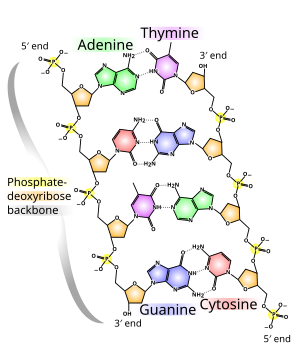
- Remember! 5' to 3' is always needed!
- Adenine and Guanine are called purines, double bonded, and Cytosine and Thymine are called pyrimidines, single bonded.
- Remember the codons! You don't need to memorize all 64 of them, but for the most part, remember that AUG/ Met is the start codon, while UAA, UAG, UGA is the stop codon. Kinda reminds you of U.A.O.H. from Chouriki Sentai Ohranger haha.

- Transcription in four parts: Initiation, RNA polymerase binds to double helical DNA at promotor 5'TATA3' (Tata box ;D) region. Unwound and shows template strands. Elongation: mRNA is synthesized from 5'-3'. Remember that T is no longer there. Termination, it's stopped. Like Arnold Schwarzenegger, AAUAA!
- Introns are inside, and exons are outside. Introns are discard because they are coding, while exons code. Simple?
- Enzymes. Somehow science has a lot of them.
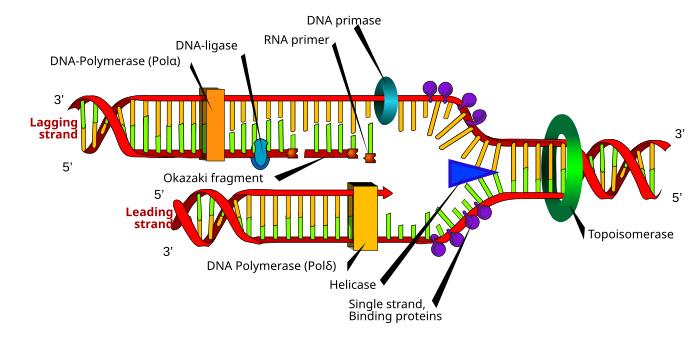
- DNA helicase: Unwinds the double helix.
- DNA ligase: it's like the glue stick. it holds all the DNA together at the end when it comes to recombinant DNA.
- Dna gyrase: relieves the tension of unwinding DNA during replication. now if only there was something like that for long days of school
- The lagging strands have short segments called Okazaki fragments built on them by the DNA polymerase III.
- Remember the old folks.
- Rosalind Franklin: Used X-Ray imaging to find hazy images of DNA and what it looked like.
- James Watson and Francis Crick: the crooks that took Franklin's findings to prove their own theory.
- Frederick Griffith: discovered teh process of transformation.
- Erwin Chargaff: discovered and founded Chargaff's rule: A=T and G=C
- Alfred Hershey and Martha Chase: suggested DNA is hereditary material.
- DNA polymerase II is really RNA polymerase II
- RNA doesn't like "T"ea. That's why when it drinks "T"ea, Uracil is excreted instead. (Vulgar, yes, but it helps me.)
Saturday, October 1, 2011
Biology Blog #1: Deaf By Design Reflection - October 1, 2011
Deaf By Design introduces the concept of Deaf Culture, and a brief genetic history of how children were born deaf.
First things first, about 20% of the time, deafness in the United States is caused by a mutation in genes for proteins called connexins 26 and 30. These proteins affect the ear's sound sensitive cochlea (See below).

Above is a simple diagram of the cochlea, courtesy of Wikipedia.
With so many deaf people now getting married, and Deaf culture becoming more commonplace in the world, a lot of Deaf couples want deaf babies, and want them a lot over hearing babies. As a result, prenatal genetic testing is being used a lot more widely to figure out if the child is deaf.
Reflecting back upon this, I don't really think that's there is anything wrong with wanting a deaf child. And knowing how a deaf baby is made was really interesting. There are many different ways of becoming deaf, and I know someone that is progressively becoming deaf, because her hearing is deteriorating. However, it's not because of the mutations in her proteins.
The video, Sound and Fury, was also useful and relevant to the topic, because it showed good emotional and visual support for the article.
First things first, about 20% of the time, deafness in the United States is caused by a mutation in genes for proteins called connexins 26 and 30. These proteins affect the ear's sound sensitive cochlea (See below).
Above is a simple diagram of the cochlea, courtesy of Wikipedia.
With so many deaf people now getting married, and Deaf culture becoming more commonplace in the world, a lot of Deaf couples want deaf babies, and want them a lot over hearing babies. As a result, prenatal genetic testing is being used a lot more widely to figure out if the child is deaf.
Reflecting back upon this, I don't really think that's there is anything wrong with wanting a deaf child. And knowing how a deaf baby is made was really interesting. There are many different ways of becoming deaf, and I know someone that is progressively becoming deaf, because her hearing is deteriorating. However, it's not because of the mutations in her proteins.
The video, Sound and Fury, was also useful and relevant to the topic, because it showed good emotional and visual support for the article.
Subscribe to:
Comments (Atom)